
Interactive Voice Response (IVR)
IVR is the abbreviation for Interactive Voice Response. This technology provides a really fast access to various data and information in an automated way making business and contact center tasks effective and easy. Introducing IVR means lower call costs and improved business.
IVR technology makes it possible to detect voice and DTMF keypad inputs by a computer. It is mainly used in telecommunication industry, however, other fields can also benefit from it.
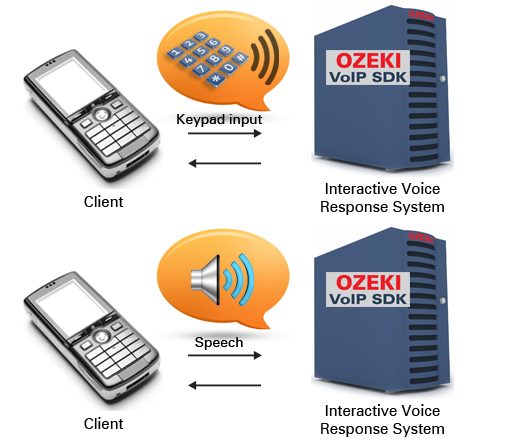
After the introduction of IVR customers or clients will be able to access to the corporate database via a simple telephone keypad or by speech recognition (Figure 1). By following the instructions they can navigate among menu points. The system is also able to respond to customers with pre-recorded or dynamically generated audio to lead users to their final goal. These systems can be adopted to handle large numbers of calls.
IVR solutions can automate both data distribution and data collection. Therefore, your computer and phone will be integrated into a voice computer that is able to transform the caller's phone into a terminal to allow the given caller to access information and services by using the touchtone keypads. The system then can provide the requested information to the caller or ask for more information.
It needs to be stated that IVR systems are not the same as Automated attendants. Automated attendants typically offer a number tree of options (For sales press 1 ...) in order to forward callers automatically to an extension without an operator. As opposed to this, IVR offers an advanced level of interaction to callers and they can also request and receive information from the system.
Fields of use
IVR systems are typically used in telecommunication industry but today other fields also often work with this technique. Businesses and organizations primarily adopt IVR systems to handle high call volumes, reduce cost and improve the customer experience.
For example IVR is implemented for telephone banking, televoting, credit card transactions. Call centers use IVR systems to identify and segment callers. IVR can also be used for collecting caller information such as product orders, credit card information, or market surveys.
Benefits of IVR
Your benefits:
- Low costs
- Extended operational hours 24/7 without increasing staff
- Reduce the number of routine, costly and time-consuming tasks of agents
- Multilingual support
- Attain a larger customer base
- Increase of overall capacity without further costs or personnel
- Provides access to live agents if it is necessary
- Save time by forwarding the caller to the wanted department in short time
- Set up voice mails for work groups and individuals
Customer benefits:
- 24-hour self-service access to data, information, and services
- Fast access via immediate and real-time interaction
- Safety is ensured by PINs or passwords