This article is a brief introduction about predictive dialer systems
in relation with Ozeki VoIP SIP SDK. After reading through this page you will
be fully familiar with all the essential terms concerning predictive dialing
and what you will need for creating your own solution using Ozeki VoIP SIP SDK.
Prerequisites:
Operating system:
Windows 8, Windows 7, Windows Vista, Windows 200x, Windows XP
System memory:
512 MB+
Free disk space:
100 MB+
Development environment:
Visual Studio 2010 (Recommended), Visual Studio 2008, Visual Studio 2005
In a call center system the communication can be started from inside or outside the system.
When an outside communication request is received it usually means that a customer calls
the call center for some reason. But there is also a possibility to start calls from inside the call center, for
example in case of a callback request.
When a call center agent performs a callback towards a customer, the calling process
also goes through the call center server, therefore there is the possibility to
implement some checking processes on the server-side. These processes can be used for
detecting the fact that the called customer's line is engaged or that
a fax machine answered the call.
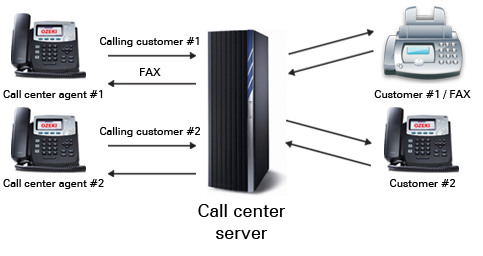
Figure 1 - VoIP predictive dialer
The call answering can be analyzed by a voice recognition system that should distinguish
between the fax machine, a busy signal or the actual human voice. The call will
only be literally established between the agent and the customer, when a human voice
answers the phone call.
In the following section you will learn how you can extend your Ozeki VoIP SIP
softphone application with the support for predictive dialing. For this purpose, you
will need to download and install Ozeki VoIP SIP SDK first.
Creating an AudioHandler for voice detection
Ozeki VoIP SIP SDK provides the possibility for extending the existing tools if you have some special
purpose to fulfill. In the case of distinguishing between a human and machine answer
you need to define a subclass for the Ozeki VoIP SIP SDK provided AudioHandler class (Code 1).
Your DetectorClass instance, as it is an AudioHandler, can be attached to an AudioReceiver
object by a MediaConnector.
class DetectorClass : AudioHandler
Code 1 - You need to define a new AudioHandler for audio detection
In this new class you will need to implement the DataReceived() abstract method inherited from
the AudioHandler class. This method is called when audio data is received from the
AudioReceiver attached to the DetectorClass object (Code 2).
DetectorClass detector = new DetectorClass();
PhoneCallAudioReceiver audioReceiver = new PhoneCallAudioReceiver();
audioReceiver.AttachToCall(call);
MediaConnector.Connect(audioReceiver, detector);
Code 2 - You will need to attach your detector object to the audioReceiver object
The algorithm that needs to be implemented in your detector class' DataReceived()
method is detailed in the next section. If you have implemented this detection algorithm,
you will be able to distinguish between a human voice and an answering machine with
a very good detection rate.
The algorithm for answering machine detection
The detection rate can never be 100% as the answering machines no longer use
standard signaling. In fact, you can make a VoIP softphone to behave as
an answering machine with only playing a .wav audio file with a single sentence like:
"I'm listening to you" and without any indication of a beep noise. Therefore modern
answer machine detection algorithms do not operate with the detection of the beep signal
but work according to the average human and machine telephoning behavior.
The following algorithm checks the length of the salutation and the silence after
the salutation as a basis. It can be stated that an average human answers the phone
by saying a simple "Hello" or maximum saying something like "Hello, this is Bob Smith speaking".
After this the called person is waiting for an answer that means there will be a
given length of silence after the salutation.
In the case of an answering machine the salutation is usually longer like
"Hello, you have called the Smith family. We are currently not at home, please leave us a message".
After this there can be an actual beep signal but it is not necessary.
If you want to distinguish between the human answer and the answering machine you will need to
set some basic variables that define the minimum, maximum and recommended length of
a given speech or silence period.
The detection algorithm needs some basic values that are shown in Table 1.
Name
Recommended Value
Default Value
Definition
MinSilencePeriod
375 (ms)
608 (ms)
Amount of time that the signal must be silent
after speech detection to declare a live voice.
AnalysisPeriod
2500 (ms)
1592 (ms)
Amount of time (from the moment the system first detects speech)
that analysis will be performed on the input audio.
MaxTimeAnalysis
3000 (ms)
8000 (ms)
The period in which CPAAnalysisPeriod must
start and stop or voice will be declared. This timer starts at off-hook.
MinimumValidSpeechTime
112 (ms)
112 (ms)
Amount of time that energy must
be active before declared speech. Anything less is considered a glitch.
Table 1 - The key values for the answering machine detection algorithm
In the following examples (Figure 1 and Figure 2) you will see how the algorithm should work
for the most effective detection rate.
Figure 1 shows the case when a person answers the phone. After the line is established
and the call started, the algorithm waits for the incoming audio data. If the audio stream
length exceeds the MinimumValidSpeechTime value, it is considered that some kind of
speech is being received.
When the algorithm detects a silence period it measures its length and if this length
exceeds the MinSilencePeriod value then the algorithm declares that the call was
answered by a person.
Figure 1 - The detection algorithm in case of a human voice
It is essential that the detection only works till the length of the speech does not
exceed the AnalysisPeriod. In the other case the algorithm declares that the call was answered by a machine
(Figure 2).
Figure 2 - The detection algorithm in case of an answering machine.
Using the AnswerMachineDetector MediaHandler
Ozeki VoIP SIP SDK from version 9.1.0 provides an inbuilt MediaHandler class for answering
machine detection that is based on the above mentioned algorithm. The example program
you can download from this page shows how you can use an AnswerMachineDetector
for your purpose to detect if the call was answered by a human or an answering machine.
As the AnswerMachineDetector is a standard MediaHandler class the usage of it is
simple and similar to the other MediaHandler objects.
Code 3 shows how you can initialize an AnswerMachineDetector object. The detector needs to be
subscribed to the DetectionCompleted event in order to realize when the detection session is
over.
manchineDetector = new AnswerMachineDetector();
manchineDetector.DetectionCompleted += manchineDetector_DetectionCompleted;
Code 3 - The initialization of an AnswerMachineDetector
The event handler method (Code 4) can be really simple. In this example it only
pops up a message box with the result of the detection. You can, of course, write
more sophisticated event handler method that serves your exact purpose. For example, if you want to
stop the call in case an answering machine answered it, you can write that code here.
Code 4 - The event handler method for the DetectionCompleted event
In order to make the AnswerMachineDetector work in a phone call, you need to connect it
to the audio receviver object that will be attached to the call (Code 5).
Code 5 - You need to connect the machine detector to the audio receiver object
The machine detector needs to be started when the call started (it is when the call state
is InCall). This means that in the phoneCall_CallStateChanged method, you need to start
the detector when the call is in InCall state (Code 6);
The detection can be stopped when the detector is able to produce a result about the remot party
but it also needs to be stopped when the call is ended, even if there is no detection result.
The end of the call is specified by the Completed call state, therefor you need to stop the
detection in the phoneCall_CallStateChanged event handler when the call stet is Completed (Code 7).
else if (e.Item.IsCallEnded())
{
phoneCallAudioReceiver.Detach();
phoneCallAudioSender.Detach();
manchineDetector.Stop();
...
Code 7 - You need to directly end the detection if the call is ended
The other parts of the sample program remains the same as in case of a standard softphone,
this means that you can paste the code for the detection into your already existing
softphone application and it will be capable of detecting if an answering machine
has answered the call.
Further possibilities
If the above mentioned functions have called your attention
contact us at info@voip-sip-sdk.com.
This article introduced you the basic knowledge about predictive dialer system
and showed how Ozeki VoIP SIP SDK can help you to fulfill your wishes about this topic. If you have read through this page carefully, you already have all the knowledge you need to start on your own solution.
As you are now familiar with all the terms concerning this topic, now it is time to take a step further and explore what other extraordinary solution Ozeki VoIP SIP SDK can provide to you.
Related Pages
For the basic knowledge about integrating Ozeki VoIP SIP SDK:
Quick start guide